Introduction
For healthcare B2B services and equipment sales, begin with a structured hospital and facility universe. Combine relevant CMS ownership, enrollment, provider, and cost-report data, segment by size, system, and geography, then monitor ownership changes and new locations as evidence for further account research.
A healthcare buying signal is an observable event, organizational change, or buyer behavior that suggests a new need, budget priority, or evaluation window. Three types matter:
- Fit signals: the account matches your ideal customer profile.
- Opportunity signals: conditions changed, such as new funding, leadership, or regulation.
- Intent signals: the account is actively researching or engaging.
This article covers which signals matter most, how to rank them, how to run them at scale, and how to turn them into outreach that respects the buyer.
Key Takeaways
- The strongest signals reveal real change in regulation, technology, capital, or leadership.
- Combine fit, opportunity, and intent, then validate and stack signals before prioritizing.
- Map each signal to a stakeholder, buying stage, source, and next action.
- Centralized workflows with human review make signal selling repeatable.
Why Healthcare Buying Signals Require a Different Approach
Committees, regulation, and risk
Define the healthcare account unit before collecting data: hospital, enrolled provider, operating facility, legal owner, or health system. Relevant CMS files can support a broad account universe, but each dataset has its own scope and identifiers; no single file is a complete record of every US healthcare business.
In HIMSS's 2025 survey, 57% of organizations involved more than five people in technology purchasing, and 23% involved more than ten. IT was involved in 95% of organizations, executive leadership in 76%, and finance in 73%.
The same survey reported that 36% had a 7-12 month purchase timeframe and 33% took more than a year. Cycles are long, so timing outreach to a real event matters.
With that many roles on the committee, one signal lands differently with each stakeholder:
- Clinical leaders ask about workflow and patient impact.
- IT and informatics ask about interfaces and deployment.
- Finance asks about cost and reimbursement.
- Compliance asks about deadlines and risk.
- Procurement asks about contract status and standardization.
Event signals versus generic intent data
An EHR migration, a CMS rule, a new facility, or a leadership change is a concrete event. Third-party intent data rarely offers that same clarity. Forrester flags differing collection methods, keyword-mapping complexity, and rapid decay of insight value when comparing providers. That finding is general B2B evidence, not healthcare-specific.
Use intent as supporting context. It is not proof of an active project.
The Most Valuable Buying Signals in Healthcare
Clinical, technology, and service-line signals
EHR migrations, interoperability projects, FHIR/API adoption, clinical AI, telehealth expansion, and new service lines all create adjacent purchasing needs. EHR adoption is near-universal, so the signal is the switch. KLAS counted 272 hospitals affected by an EHR purchase decision in 2024, versus 319 in 2023.
Other context from ONC and AHA data:
- 43% of hospitals routinely engaged in all four interoperability exchange domains in 2023.
- 71% reported predictive AI integrated with the EHR in 2024.
- 86.9% offered telehealth in 2022.
Combine the appropriate hospital and facility datasets, Care Compare provider information, enrollment and ownership files, and relevant cost reports. Use them to investigate location, facility type, scale, ownership, and system relationships. Check publication notes and definitions before treating a field as a current commercial attribute.
Facility, capital, and growth signals
New hospitals, ambulatory centers, medical office buildings, department expansions, Certificate of Need filings, bond activity, and capital announcements point to demand for equipment, infrastructure, software, implementation, and staffing.
- 35 states and Washington, D.C., ran CON programs as of January 2025, per NCSL, and coverage varies by state.
- Fitch's 2026 outlook for nonprofit hospitals noted continuing capital spending, shifting toward outpatient services, access points, and IT.
- Census data show $49.6 billion in healthcare construction put in place through August 2026 (a broader category than hospitals).
Regulatory, reimbursement, and funded-program signals
Rules and funded programs create deadline-driven buying. Verify every date against the current authoritative source before you use it in outreach.
- CMS-0057-F: CMS states that Patient Access API metric reporting begins January 1, 2026, and the cited API requirements are due by January 1, 2027. Check payer-specific applicability.
- ONC HTI-1: effective March 11, 2024, with FHIR US Core and SMART 2.0.0 named for the standardized API criterion.
- HIPAA Security Rule: OCR's December 2024 proposal is not a final deadline. Confirm status first.
- ACOs: CMS lists 511 Shared Savings Program ACOs and 74 ACO REACH participants for 2026.
- Rural health: CMS announced $50 billion over five years, awarded through states.
Organizational and financial signals
New CIO, CMIO, CFO, CISO, COO, or CEO appointments often precede vendor reviews. ACHE reported 16% hospital CEO turnover for 2022, a historical baseline rather than a current rate.
Mergers and affiliations suggest consolidation. Kaufman Hall counted 16 transactions in Q3 2026 and 46 for full-year 2025. Margin pressure is another cue: year-to-date operating margin was 2.5% with allocations in August 2026. Thin margins tend to favor cost-reduction and revenue cycle conversations.
Workforce, cybersecurity, and operational pain signals
Hiring for implementation, informatics, cybersecurity, revenue cycle, population health, analytics, and workforce management hints at active initiatives. BLS projects 16% growth for health information technologists from 2025 to 2035. That figure is an occupational projection, so evaluate job postings account by account.
On security, OCR's 2024 report counted 663 large breaches. HHS publishes breaches of 500 or more individuals, so a listed breach is public evidence. Do not speculate about undisclosed incidents or use protected information.
Connect each signal to a need and stakeholder
For every signal, answer four questions:
- What changed?
- What problem could it create?
- Which stakeholder likely owns it?
- What evidence justifies outreach?
| Signal | Likely need | Likely owner |
|---|---|---|
| EHR migration | Interfaces, training, analytics | CIO, CMIO |
| New ambulatory center | Equipment, software, staffing | COO, facilities |
| ACO announcement | Population health tools | CMO, finance |
| New CISO | Security assessment, tooling | CISO |
No signal guarantees a purchase.
How to Evaluate and Prioritize Healthcare Buying Signals
Classify signals as fit, opportunity, or intent
Score accounts across three layers:
- Fit: whether the account matches your profile
- Opportunity: a change in budget or conditions
- Intent: active research underway
One layer alone misleads. A perfect-fit account with no change is a nurture target; a hot intent spike at a poor-fit account is noise.
Rank by evidence, urgency, and actionability
Score each signal on:
- Source reliability and recency
- Stated budget or implementation deadline
- Strategic relevance
- Proximity to your solution
Set your own weights and test them against closed deals. No universal ranking exists.
Stack signals, then validate
An ACO announcement plus population health hiring is stronger than either alone. An EHR announcement plus implementation roles beats a press release. Stacked signals still need account research.
Before acting, confirm:
- Original source and publication date
- Account identity and parent-system relationship
- Relevance to your offering
Then label each signal:
- Confirmed: primary source verified.
- Probable: credible but incomplete.
- Exploratory: worth watching.
Map each signal to buying stage next. A construction announcement points to strategy and capital planning. A compliance deadline pulls in IT, compliance, procurement, and finance.

How to Operationalize Buying Signals at Scale
Build a source map and centralize by system
Monitor CMS, HHS/OCR, ONC, state agencies, procurement portals, SEC filings, earnings calls, job boards, health system websites, trade press, and professional networks. Separate public evidence from unverified commentary.
Connect facilities to parent systems and shared-services teams rather than treating each hospital as its own account. Store the signal, source link, date, business unit, likely stakeholder, and suggested next action.
Create triggered workflows
When a signal fires, run a fixed sequence: enrich the account, identify contacts, assign an owner, attach the source, pick a playbook, and set a dated follow-up. Route work down one of three paths:
- High urgency (compliance deadlines): immediate review.
- Medium term (transformation): research and multi-threaded outreach.
- Early strategic: monitor and nurture.
Deliver verified alerts inside the CRM or collaboration tools. Prevent overload with filtering, deduplication, confidence labels, and human review.

A customizable workflow layer
When off-the-shelf tools fall short, a build platform can close the gap. Intellectible is a horizontal AI build platform that connects data, business rules, decisions, human review, interfaces, and automations.
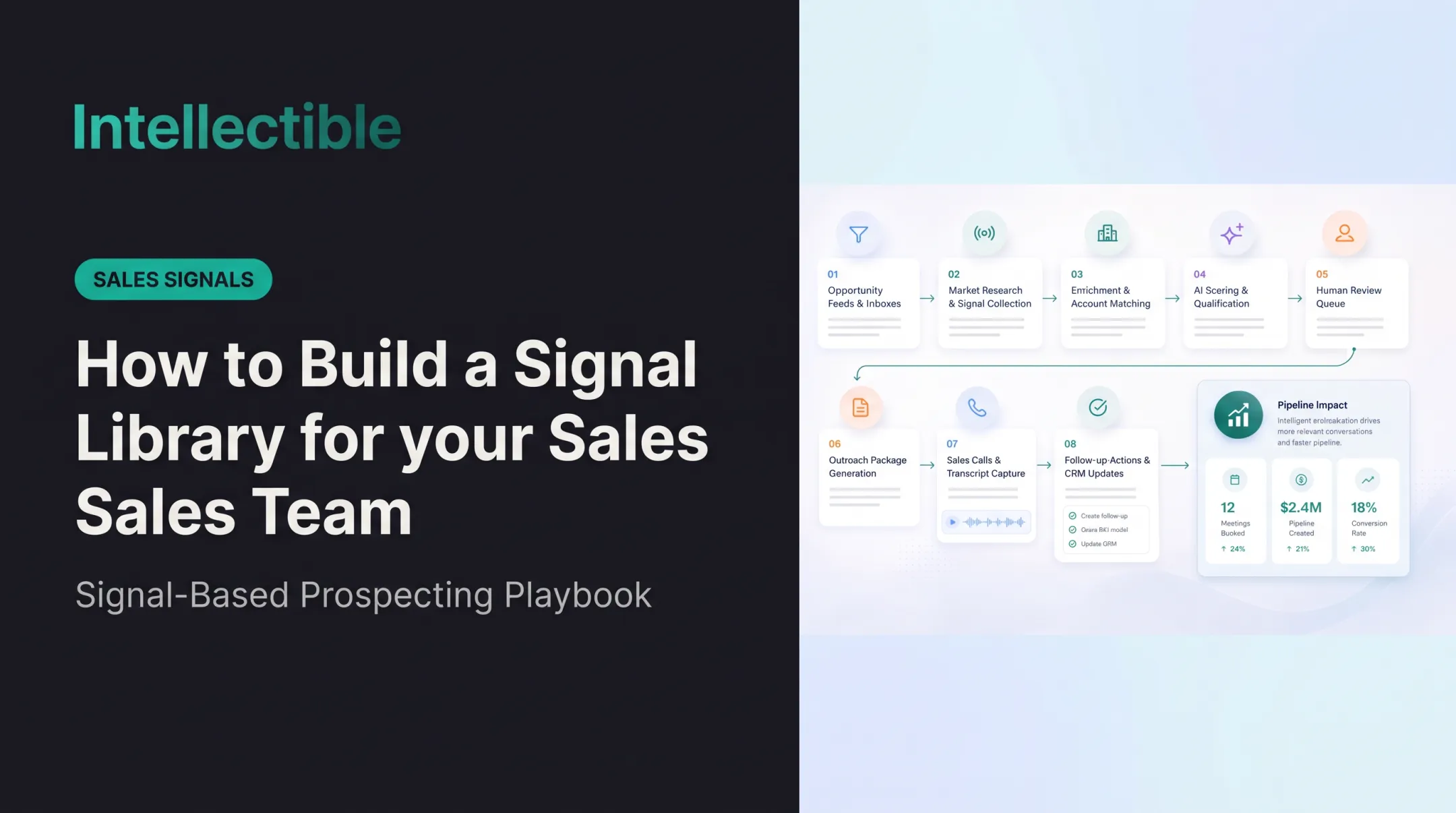
Its Revenue Discovery engine lets teams define their own signal rules and ranks accounts by fit and urgency with reasoning attached. Four human approval gates sit before outreach or CRM updates. The operating flow is Detect, Gate, Promote, Draft, Approve, Call, then Qualified.
Teams can scale opportunity research without adding headcount. Data coverage depends on the sources you connect.
Measure impact
Set a baseline first, then track:
- Signal-to-meeting and signal-to-opportunity conversion
- Response time and research time saved
- Stakeholder coverage and pipeline influence
- False-positive rate
Review monthly before claiming results.
How to Turn Signals Into Healthcare Sales Outreach
Match message to signal and stakeholder
Turn each signal into outreach in four steps:
- Cite the verified event
- State its likely operational implication
- Tie it to the reader's role
- Ask a discovery question
Never assume a purchase is underway. Match the message to what each stakeholder cares about:
- CIO/CMIO: interfaces, deployment effort, support
- CFO: cost, reimbursement, payback
- Clinical leader: workflow and patient impact
- CISO: risk and approved security documentation
- Procurement/value analysis: contract status, standardization, evidence
For device sales, AHRMM criteria cover clinical evidence, outcomes, cost, reimbursement, and standardization. Lead with evidence, workflow impact, and economic value.
A signal-based example
Suppose a regional system announces an ACO and posts two population health analyst roles. A message to the CMO might read:
"I saw the announcement of your ACO participation and your open population health analyst roles. Teams starting risk-bearing work often struggle to unify care-gap data across sites. How are you approaching that today?"
It cites two public sources, claims no budget, and asks a question.
Follow up with respect
Mix email, phone, professional-network engagement, and useful educational content. HIMSS found 89% of buyers trust peers and networks, 81% associations, and 72% in-person events.

Nurture early-stage signals instead of pushing for a meeting. Some systems also restrict access: Yale New Haven's 2024 vendor policy prohibits cold calls and requires registration.
Protect trust and compliance
- Never reference patient information or infer confidential clinical events.
- Never exploit an unacknowledged breach, or imply knowledge beyond the public source.
- Verify sources and review privacy practices.
- Use approved security and compliance materials.
- Follow procurement requirements.
HHS guidance generally requires authorization before PHI is used for marketing.
Frequently Asked Questions
What should count as a healthcare account?
Define the healthcare account unit before collecting data: hospital, enrolled provider, operating facility, legal owner, or health system. Relevant CMS files can support a broad account universe, but each dataset has its own scope and identifiers; no single file is a complete record of every US healthcare business.
Which CMS datasets should be combined?
Combine the appropriate hospital and facility datasets, Care Compare provider information, enrollment and ownership files, and relevant cost reports. Use them to investigate location, facility type, scale, ownership, and system relationships. Check publication notes and definitions before treating a field as a current commercial attribute.
How should hospital and parent identities be matched?
Normalize CCNs, NPIs where relevant, legal names, addresses, parent relationships, and facility identifiers. Deduplicate without collapsing distinct sites into one buying entity. Ownership changes, newly observed facilities, and altered system links should enter a verification queue before account routing.
How should size and ownership segmentation handle stale data?
Segment the universe by the size proxy, facility type, geography, system, and ownership relevant to the offer. Check reporting periods and revision dates: cost reports can lag current operations, and a changed public record may reflect a correction rather than a new business event.
How should this process be put into practice and measured?
Monitor ownership changes and new locations across the full eligible healthcare market. Give sellers the source, date, matched entity, possible service need, decision-owner hypothesis, and what still requires confirmation. A CMS listing does not reveal an account’s private vendor contracts or establish an active purchasing process. Maintain source refresh checks, entity-resolution tasks, account ownership, and evidence-backed seller queues. Compare coverage with purchased lists, then measure accepted accounts and healthcare sales-accepted opportunities. The result should be a reusable market-research system, not a one-time hospital spreadsheet.