Introduction
A signal inside the CRM is useful only when the sales process defines what happens next. Apply a market-specific library, eligibility gates, observed-versus-inferred evidence, ownership, and contact-now or research-needed queues. Give the rep an action package and measure the resulting sales-accepted opportunity rather than the task count.
Most teams struggle here. Forrester's 2026 analysis points to immature intent use, weak measurement, and poor integration into internal systems.
One signal is not a buying decision. Its meaning depends on account fit, recency, context, and what else is happening on the account.
This guide covers how to define, score, route, act on, and measure buying signals in your CRM, while avoiding alert fatigue, bad data, and generic outreach.
Key Takeaways
- A signal is useful only when it triggers a defined next action.
- Layer behavioral, firmographic, technographic, conversational, and opportunity signals.
- Set thresholds using fit, recency, stage, and buying-group coverage.
- Send every alert with enough context to personalize and log the result.
- Review outcomes regularly to tune scoring, routing, and adoption.
How to Act on Buying Signals Inside Your CRM
Step 1: Define the signal taxonomy and audit the CRM
Start with an inventory of what you can already capture:
- Website and content engagement, form fills
- Email and meeting activity
- Job and leadership changes, funding, expansion, M&A
- Technology changes and competitor activity
- Opportunity-stage movement
Apply eligibility gates before priority: serviceable geography, correct entity, relevant need, delivery fit, account ownership, and an open decision window. Distinguish observed facts from inferred needs. A company announcement can establish a new site; whether that site needs your service remains a hypothesis for qualification.
Audit before you automate. Validity's 2024 CRM survey found 53% of respondents report duplicate records and 68% report incomplete data. Check ownership rules, stale contacts, consent status, and field availability too.
Step 2: Enrich and layer signals for account-level context
Connect first-party and external sources to account, contact, and opportunity records. Enrichment should fill missing roles, buying-group members, technologies, company changes, and relationship history.
Then combine signals inside a defined time window. Repeat engagement plus a relevant business event, such as a new operations leader, says more than one content download. Forrester's guidance is to pair intent with engagement and technographic data and map signal types to buying stage.
Treat published scoring models as unproven for your market. Test signal combinations against your own ICP's history rather than copying another team's model.
Account-level context also means covering the full buying group. Forrester reports 13 internal participants on average in a B2B purchase, so one engaged contact rarely tells the full story.
Step 3: Create signal tiers, routing rules, and response SLAs
Define low, medium, and high tiers using specificity, fit, recency, opportunity status, and the number of aligned stakeholders or events. Map each tier to a CRM action:
- Low: nurture enrollment or an account-research task
- Medium: SDR assignment or buying-group expansion
- High: AE notification, manager review, or opportunity inspection
Set response windows by urgency, and name one owner. Territories, account teams, SDRs, marketing, and RevOps will otherwise send conflicting follow-ups.
Step 4: Give sellers context, activate outreach, and close the loop
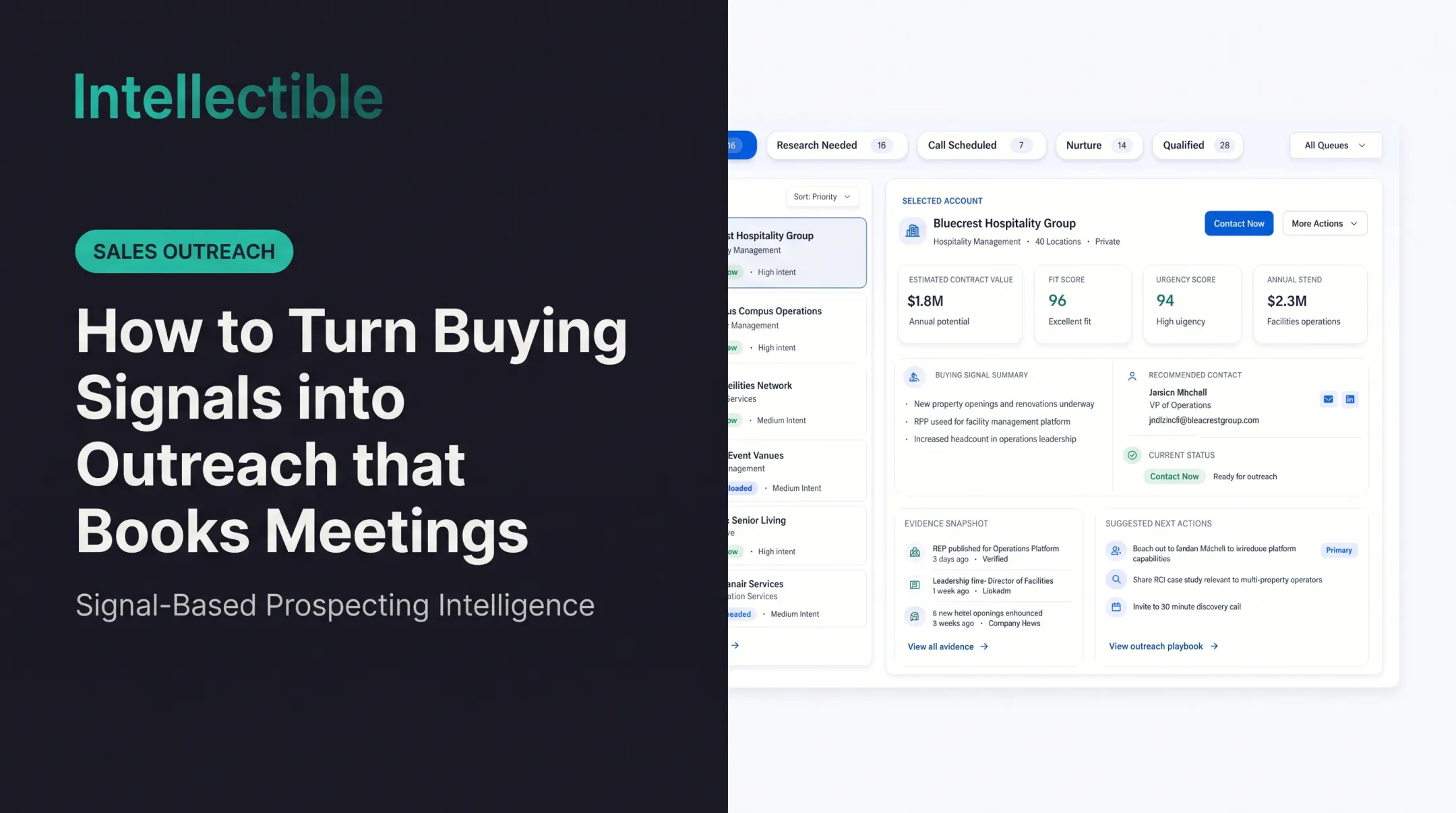
Every alert should carry:
- Account, person, and signal type
- Source, timestamp, and relevant pages or topics
- Opportunity stage, known stakeholders, and a suggested reason to reach out
Sellers should personalize around the business context, not reveal tracking details or fire off a generic sequence. Then log the action, buyer response, opportunity change, disqualification reason, and signal outcome. RevOps uses that record to find useful signals and suppress repeat false positives.
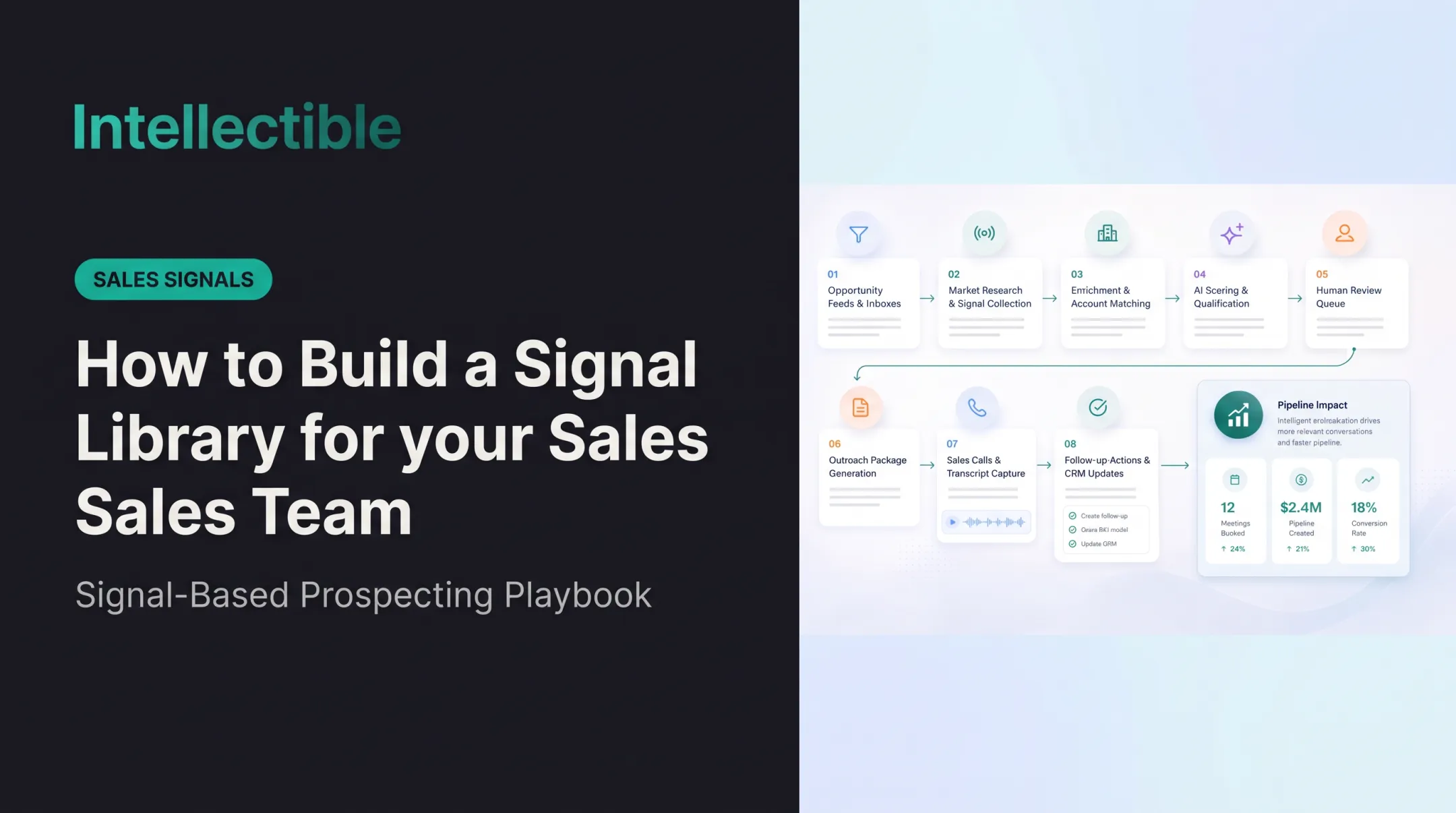
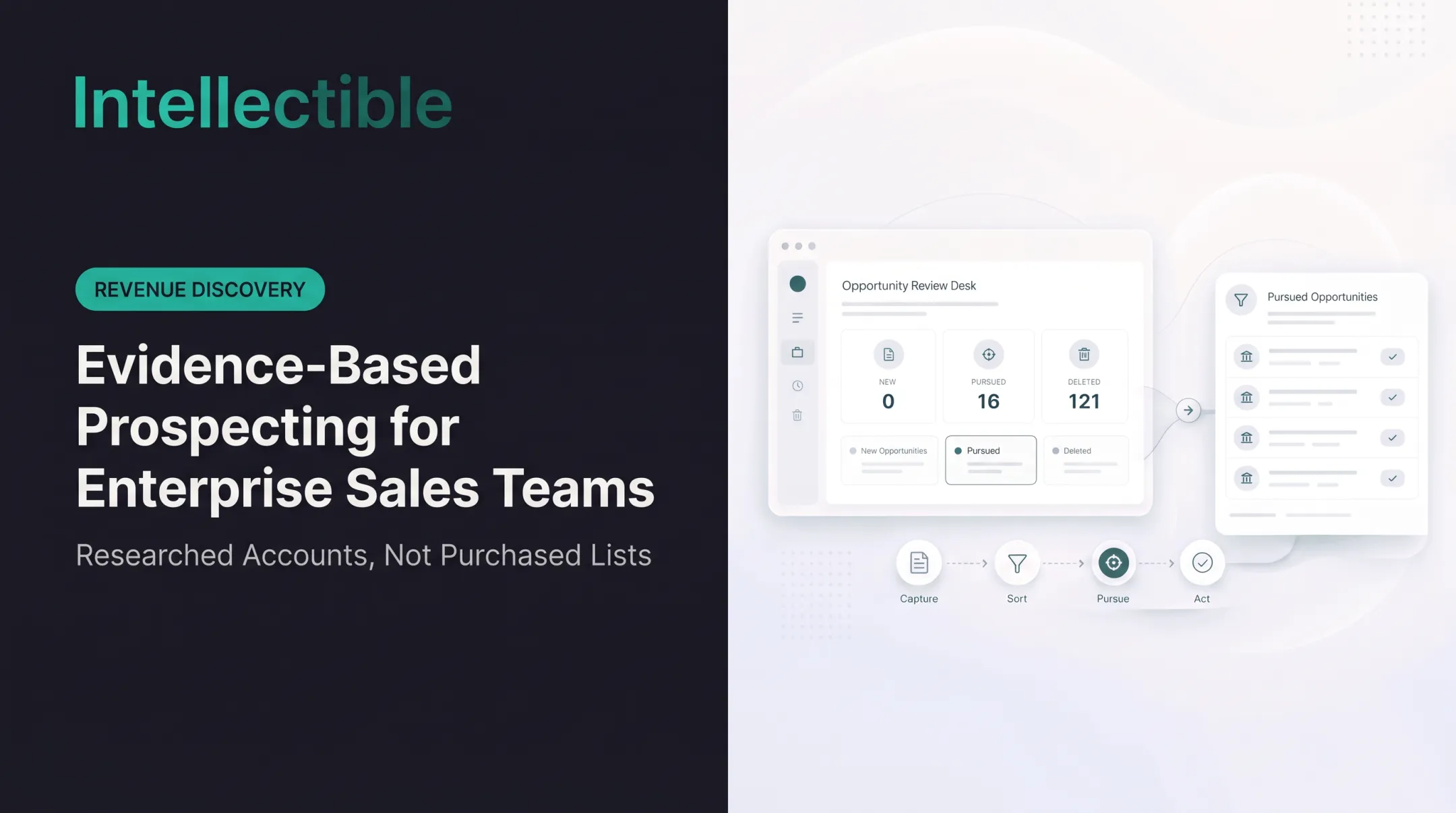
Some teams build this with a visual workflow tool. Intellectible's Revenue Discovery Engine, for example, runs a Detect → Gate → Promote → Draft → Approve → Call → Qualified flow. Its approval gates require human sign-off before outreach or Salesforce updates, and signal weights are editable in the admin.

When Should You Act on Buying Signals, and What Do You Need First?
When signal-based action is the right fit
Signal-led selling pays off in complex motions: long cycles, multiple stakeholders, high account values, or large target lists. Good use cases include:
- Prioritizing active opportunities
- Spotting new buying committees
- Re-engaging former champions
- Responding to evaluation behavior
- Catching business changes before a form is ever submitted
When a signal should not trigger immediate outreach
Log or nurture, don't route, when the activity is:
- A single low-specificity action
- Anonymous or stale
- From a poor-fit account
- Compliance-restricted
Forrester warns that intent must not replace qualification. An account can be active in a category without being ready to talk. Require corroboration from fit, recency, repeat behavior, or a relevant event.
CRM, data, and workflow requirements
Build on these CRM foundations:
- Reliable account and contact matching
- Opportunity ownership and timestamped activity history
- Custom fields, rules, or scoring
- Task and notification support
- Workflow automation, permissions, and reporting
Add fields for:
- Signal type, source, and date detected
- Account fit and confidence
- Assigned owner
- Action taken and response
- Resulting opportunity status
Team and compliance readiness
Assign responsibilities before launch:
- RevOps and CRM admins: data, rules, reporting
- Marketing: signal sources and nurture
- SDRs and AEs: follow-up and logging
- Managers: inspection and escalation
- Security and legal: consent, access, retention
The FTC says CAN-SPAM has no B2B exception: honor opt-outs within 10 business days and include a physical address. Calls and texts carry separate consent rules under the TCPA. California's CCPA also covers business contacts.

Apply these controls from day one:
- Data minimization
- Role-based access (least privilege)
- Retention limits and audit trails
Key Parameters That Affect Signal-to-Action Results
Prepare an action package for every promoted account: evidence links, event date, fit rationale, likely decision-maker, what remains unknown, a suggested outreach angle, and a next step. Draft the email or call brief around the account change, then require human review rather than treating an automated draft as permission to send.
Signal specificity and source quality
Separate direct first-party actions, inferred third-party intent, public business events, and internal opportunity signals. A demo request or procurement review justifies faster action than an isolated page view. Third-party intent is often account-level interest, not proof a specific person is ready.
Recency and response timing
Intent is time-sensitive, and old signals need decay or every account eventually looks in-market. No universal half-life exists, so set windows by signal type and measure elapsed time from detection to first action.
Response-time studies concern inbound web leads. The MIT/InsideSales research found contact odds fell sharply between five and 30 minutes. Treat that as support for fast replies to explicit inquiries, not an SLA for job changes.
Account fit and buying-group coverage
A moderate signal from a high-fit enterprise account can beat a strong one from outside your ICP. Firmographics, technographics, seniority, existing relationships, stage, and missing stakeholders should change both routing and message.
Signal combinations and scoring thresholds
Layered signals separate research from active evaluation. Test thresholds against closed-won, closed-lost, stalled, and disqualified opportunities, then adjust weights based on conversion and false positives. Hold out recent records for validation.

CRM usability and seller adoption
Accurate signals fail inside a disconnected dashboard. Deliver them in the seller's existing workflow, keep alerts short, suggest a next action, and collect feedback without extra data entry. Salesforce reports reps spend about 60% of their time on non-selling tasks, so every extra click costs.
Common Mistakes, Troubleshooting, and Alternatives
Common mistakes
- Treating every engagement as intent. One download or page view needs fit and context.
- Automating before cleaning ownership, contact roles, stages, and duplicates.
- Sending generic outreach that exposes tracking or ignores existing conversations. Gartner found 73% of surveyed B2B buyers avoid irrelevant outreach.
- Measuring alert volume instead of response, meeting quality, progression, and attribution.
Troubleshooting
No signal appears: check these areas:
- Source permissions, identity resolution, and account matching
- Field mapping, sync timing, and filters
- Whether the threshold is too tight
Too many alerts: look for:
- Duplicate events, weak thresholds, and overlapping workflows
- Low-fit accounts, stale signals, and missing suppression rules
Roll alerts into account-level summaries.
Outcomes don't improve: review:
- Message relevance, timing, and ownership
- Buying-group coverage and qualification
- Whether the signal actually predicts progression in your segment
Alternatives to full automation
- Manual account research: fine for small lists, but coverage is uneven and stale.
- Nurture-first routing: suits low-intent or anonymous activity, though it is slower to build a coordinated enterprise motion.
- Rep-led qualification: suits sensitive, high-value deals, but costs human time and drifts without shared rules.
Conclusion
Acting on buying signals works when reliable data meets clear ownership, priority tiers, contextual outreach, and measured follow-up. Most failures trace back to weak definitions, too many alerts, incomplete buying-group data, or leaving the next step to individual judgment.
The strongest programs balance automation with human review, so sellers move fast without losing relevance, governance, or buyer trust.
Frequently Asked Questions
What belongs in a signal-based selling process?
Signal-based selling is a team process. For a $20M–$500M company with a sales organization, begin with the market, service offer, buying roles, and six signal families. Give each signal a definition, source, evidence standard, freshness rule, disqualifier, and owner. A tool cannot compensate for unclear eligibility or an unowned follow-up process.
Which eligibility gates come before outreach?
Apply eligibility gates before priority: serviceable geography, correct entity, relevant need, delivery fit, account ownership, and an open decision window. Distinguish observed facts from inferred needs. A company announcement can establish a new site; whether that site needs your service remains a hypothesis for qualification.
How should account queues work?
Separate the work into contact-now, research-needed, nurture, and monitor queues. Define what moves an account between queues and who approves the decision. Uncertain entity matches, missing dates, and unclear commercial relevance belong in research, not automatically in a sales sequence.
What should a seller action package include?
Prepare an action package for every promoted account: evidence links, event date, fit rationale, likely decision-maker, what remains unknown, a suggested outreach angle, and a next step. Draft the email or call brief around the account change, then require human review rather than treating an automated draft as permission to send.
How should this process be put into practice and measured?
Use CRM ownership, duplicate checks, task deadlines, and feedback to coordinate the team. A signal record should retain its source and decision history when promoted to an account, meeting, or opportunity. Rejected and deferred accounts also need reasons, so the research process learns from seller decisions. Measure the full chain: signals reviewed, eligible accounts, rep acceptance, time to first touch, meetings, sales-accepted opportunities, and sourced pipeline. Compare by signal family and segment. This operating loop is the playbook; alert volume, automated emails, and a new platform licence are inputs rather than business outcomes.