Introduction
Responding to a buying signal is an operating decision: is this account eligible, is the evidence real, and what should the rep do next? For enterprise sales teams, the answer belongs in a shared playbook with a signal library, review queues, approved action packages, and outcome measurement.
A buying signal is evidence of possible intent, not an instruction to contact someone. Buying is also messy. Forrester reports 13 people on average are involved in a B2B decision, so one click rarely tells the story.
This guide covers how to assess context, rank signal strength, pick the right response, and turn all of it into a repeatable team process.
Key Takeaways
- A signal's meaning depends on fit, timing, authority, account status, and surrounding behavior.
- Patterns across stakeholders or channels beat any single page visit or download.
- The right response might be outreach, enrichment, nurture, handoff, or doing nothing.
- Document signals and outcomes so responses get faster and more consistent.
What Are Buying Signals in B2B Sales?
Signal-based selling is a team process. For a $20M–$500M company with a sales organization, begin with the market, service offer, buying roles, and six signal families. Give each signal a definition, source, evidence standard, freshness rule, disqualifier, and owner. A tool cannot compensate for unclear eligibility or an unowned follow-up process.
An intent signal is broader. Research activity shows interest, but it doesn't prove the buyer is evaluating a purchase now. No formal industry standard separates the two terms, so treat this as a practical working distinction: a signal is the observed event, and intent is your interpretation of it.
Three categories to monitor
- Conversational: pricing questions, implementation concerns, objections, requests for next steps.
- First-party behavioral: demo requests, trial activity, repeat visits to pricing or technical pages, bottom-of-funnel content engagement.
- Account and third-party: leadership changes, hiring, funding, RFP activity, competitor dissatisfaction, former champions changing companies.
Provenance matters. A TechTarget report notes that first-party activity may not identify the person, while some third-party data lacks content context or any evidence the behavior relates to buying.
How to Judge Whether a Buying Signal Is Strong
Strength is contextual, not fixed. A pricing-page visit from an existing customer's finance lead means something different than the same visit from a student.
Test every signal against five questions:
- Explicitness: Did they ask directly for pricing, a proposal, a demo, a timeline, references, security details, or implementation specifics? That outranks passive reading.
- Authority and role: Is this a researcher, or a budget owner, executive sponsor, procurement contact, or technical evaluator asking decision-stage questions?
- Recency and frequency: Is activity recent, repeated, and increasing? TechTarget weights role, recency, frequency, and buying-group linkage, and rates point-in-time signals as weaker.
- Progression: Is the buyer moving from education toward evaluation or internal approval?
- Account state: Is there an open opportunity, an active sequence, an existing customer relationship, or a recent closed-lost decision?
Stack signals before acting
Combine fit, behavior, conversation, and account events. Pricing activity, plus a new IT stakeholder on the thread, plus a stated deadline is a strong pattern. Any one of those alone is a prompt to watch.

One caution: no benchmark exists for the conversion lift from stacking, so build your own weights and test them against outcomes.
Within that stack, check account state before anything else. Emailing a prospect mid-negotiation with a cold-sounding message creates friction your seller then has to repair.
B2B Buying Signals and the Right Response to Each
Conversational signals that call for a specific answer
These questions signal active evaluation:
- Pricing and contract terms
- Implementation timelines and integrations
- Security reviews and ROI
- Competitor comparisons
- Procurement concerns and reference requests
Answer the question asked. Reduce risk; do not deliver a pitch.
References matter here. In TrustRadius's 2024 survey, 83% of buyers rated vendor-provided references helpful or very helpful, and 89% said the same of peer conversations.
High-intent actions on owned channels
High-intent actions on your channels include:
- Demo requests and trial sign-ups
- Proposal requests
- Repeat pricing-page visits
- Documentation engagement
- Product usage changes
Before you follow up, tie the action to the person's likely use case. "Saw you looked at our API docs" is creepy. "Here's how teams with your CRM setup handle the integration" is useful.
Buying-group and stakeholder signals
When a prospect brings in finance, IT, procurement, legal, executives, or end users, internal alignment work is usually underway. Map each person's concern and prepare role-specific proof:
- Security summary for IT
- Cost model for finance
- Contract terms for legal
Account-level and third-party signals
Events like these can open doors:
- Leadership changes and hiring patterns
- Funding rounds and RFPs
- Mergers and competitor dissatisfaction
- Job changes on the account
Validate the business reason first. A funding round may mean growth spending or a hiring freeze. No vetted study quantifies the win-rate effect of champion loss or trigger events, so rely on judgment and your own data.
Weak signals and false positives
These deserve nurture, segmentation, or monitoring, not a pitch:
- One-off website visits
- General content downloads
- Social likes
- Newsletter subscriptions
- Webinar registrations with no follow-up
A Practical Framework for Responding to Buying Signals
1. Confirm the signal and its context
Verify who acted, what they did or said, when, which account they represent, their role, and whether it's part of a larger pattern. Data quality is a real risk: in Salesforce's 2024 survey of 5,500 sales professionals, only 35% completely trusted their organization's data accuracy.
2. Match the response to stage and role
- Early researcher: useful education, not a sales call.
- Champion: materials they can forward internally.
- Executive: concise business case and peer proof.
- Finance: ROI evidence and pricing structure.
- IT: technical documentation and security answers.
- Procurement: contract terms, references, implementation scope.
3. Use signal, audience, offer
Prepare an action package for every promoted account: evidence links, event date, fit rationale, likely decision-maker, what remains unknown, a suggested outreach angle, and a next step. Draft the email or call brief around the account change, then require human review rather than treating an automated draft as permission to send.
Compare two cases:
- Weak signal: A pricing-page visit from an unknown contact, so enrich the account and monitor.
- Strong signal: A new technical evaluator joining an open opportunity; the audience cares about integration and security, so offer a technical walkthrough with documentation.
4. Choose the action, not default outreach
Your options include:
- Suppress a duplicate contact
- Enrich the account
- Move the contact into nurture
- Reprioritize the opportunity
- Update owned content
- Alert the seller
- Hand off to customer success or another owner
- Contact the buyer directly
Restraint pays. Gartner found that 73% of B2B buyers actively avoid suppliers who send irrelevant outreach.
5. Respond with proof and a clear next step
Acknowledge the signal without sounding like surveillance. Reference something the buyer said or asked, not that you watched them browse.
From there:
- Add one verified piece of evidence
- Ask one useful question
- Offer a low-friction next step, such as a 15-minute call or a short document
6. Capture the outcome
Record the signal, response, stakeholder concerns, next step, and result in the CRM or shared revenue system. The next person to touch the account shouldn't have to start over.

Make Buying-Signal Response a Revenue-Team Process
Create a shared taxonomy, ownership model, and response matrix
Agree on the basics:
- Standard signal categories and strength levels
- An owner for each category
- Escalation rules and response windows
- Definitions of when marketing, sales, RevOps, customer success, proposal, or pricing teams act
No universal benchmark exists for handoff windows. The InsideSales figures on speed—an 8X conversion difference for contact within five minutes, from a 2021 vendor study of inbound leads—are not a B2B-specific SLA.
Set windows by signal strength: fast for direct requests, slower when context is thin.
Connect data sources while preserving human judgment
Pull together the sources that actually move deals:
- CRM history
- Website and content activity
- Email and meeting notes
- Product or trial usage
- Account events and buying-group information
Limit duplicate alerts, or reps will tune them out. Require human review for consequential decisions such as outreach to a key account or CRM changes.
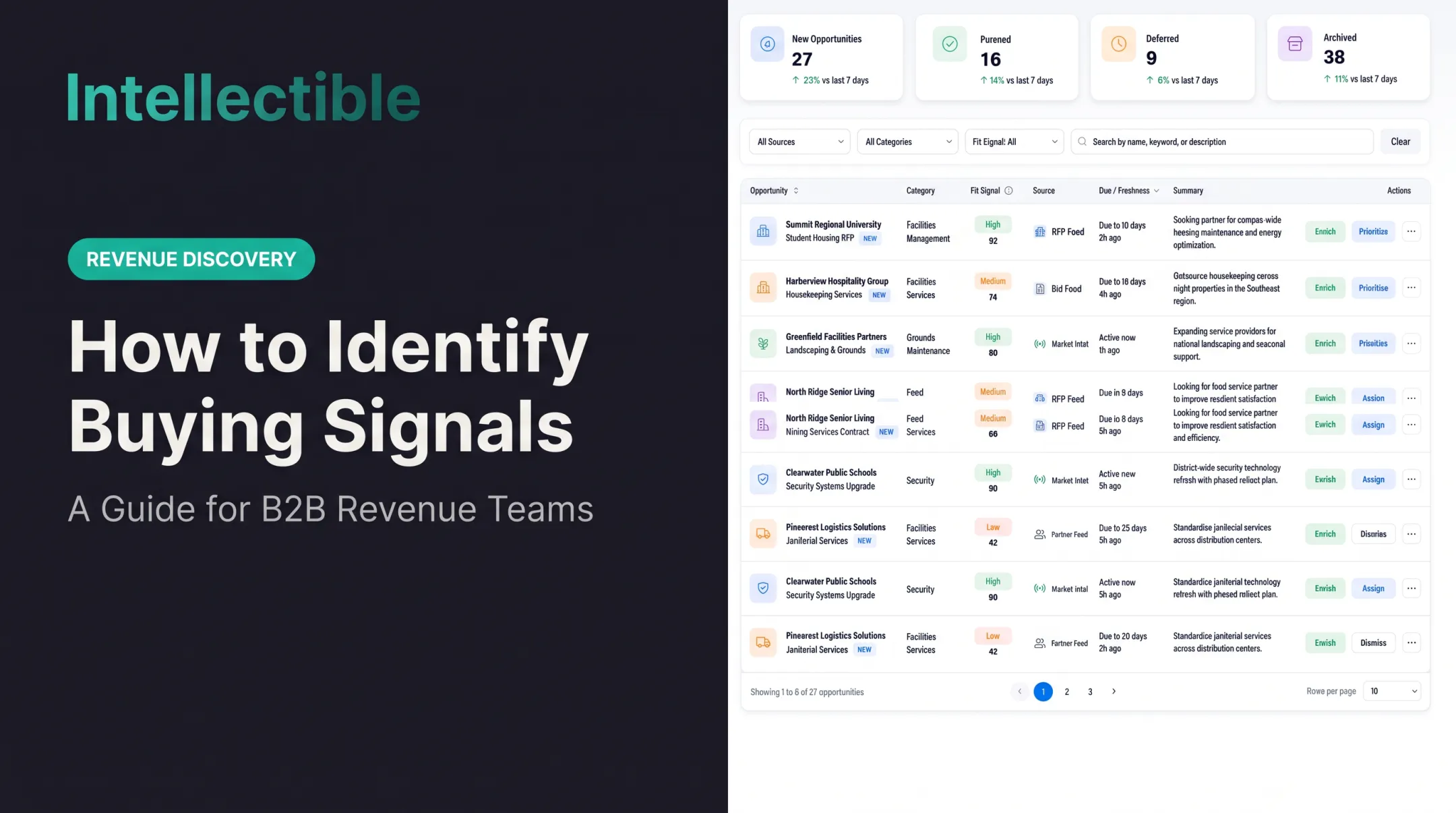
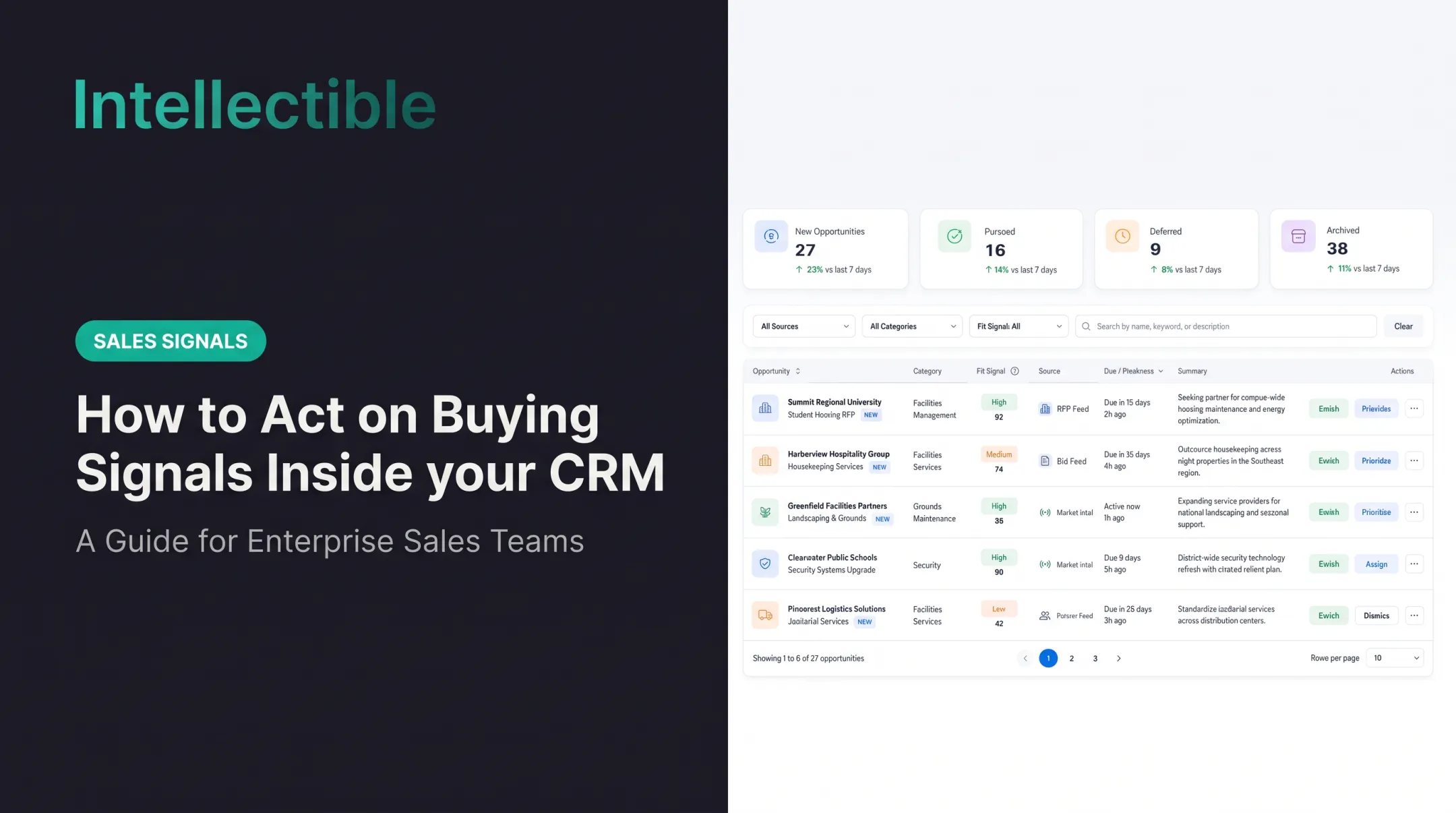
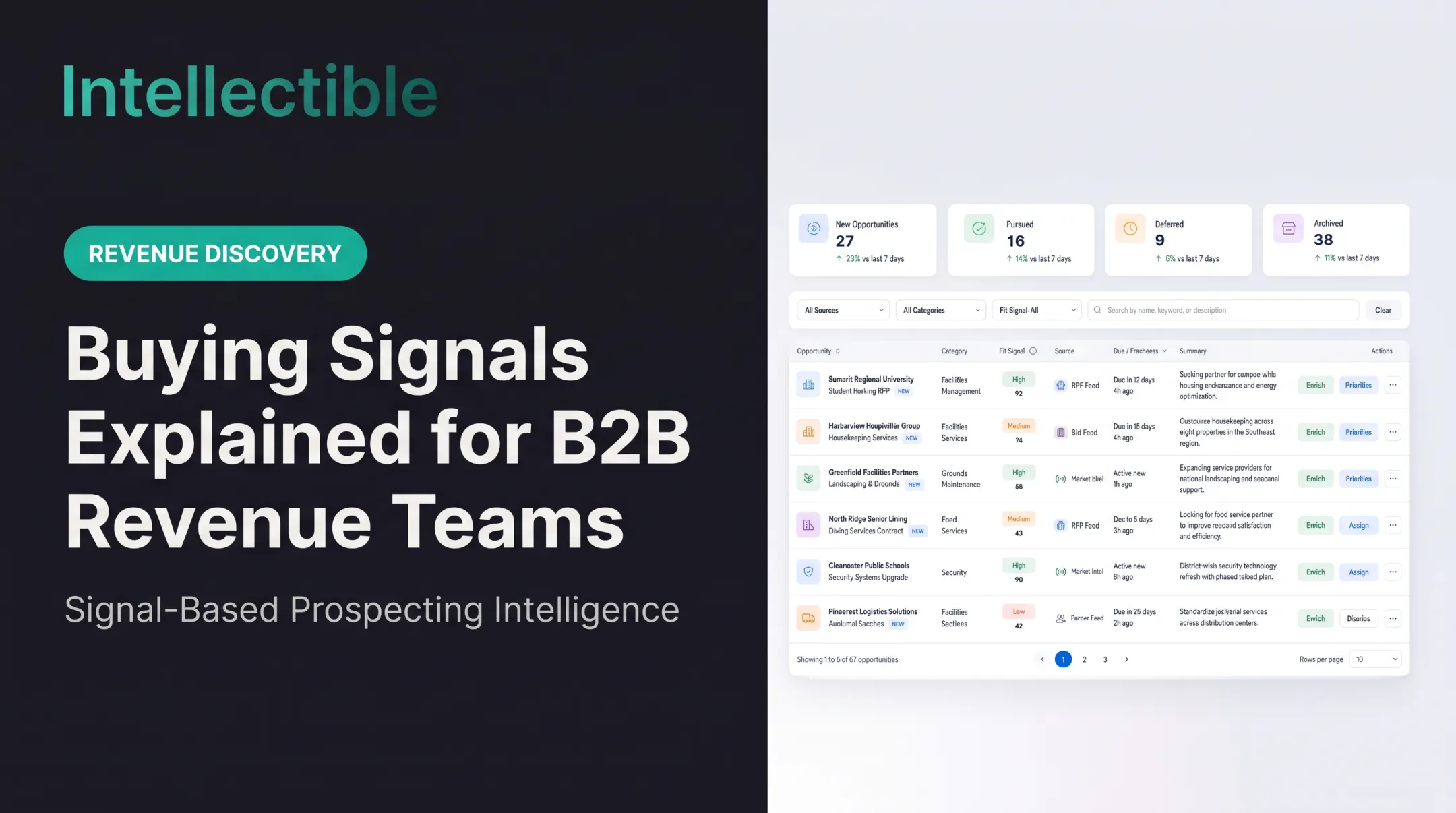
Platforms can help here. Intellectible, a horizontal AI build platform, offers a Revenue Discovery engine that monitors signals such as funding rounds, hiring pressure, leadership changes, expansion, and M&A. Accounts are scored for fit and urgency with editable weights.

Its workflow runs:
- Detect
- Gate
- Promote
- Draft
- Approve
- Call
- Qualified
It drafts but never sends: no bulk email, no LinkedIn automation, and no automatic CRM writes. A person approves outreach and updates.
Measure quality, not just activity
Track:
- Response accuracy and false positives
- Meeting quality and opportunity progression
- Conversion by signal combination
- Time to follow-up
- Suppressed outreach
- Stakeholder coverage
Don't borrow generic conversion benchmarks. No transparent, current benchmark exists for MQL-to-opportunity rates or intent-data false positives, so your own baseline is the best comparison.
Conclusion: Treat Buying Signals as Context, Not Commands
The best revenue teams don't chase every sign of interest. They read patterns, respect account context, choose the least intrusive action that moves the deal forward, and log what happened.
Start with one signal category, one owner, and one response rule. Then refine it as outcomes come in.
Frequently Asked Questions
What belongs in a signal-based selling process?
Signal-based selling is a team process. For a $20M–$500M company with a sales organization, begin with the market, service offer, buying roles, and six signal families. Give each signal a definition, source, evidence standard, freshness rule, disqualifier, and owner. A tool cannot compensate for unclear eligibility or an unowned follow-up process.
Which eligibility gates come before outreach?
Apply eligibility gates before priority: serviceable geography, correct entity, relevant need, delivery fit, account ownership, and an open decision window. Distinguish observed facts from inferred needs. A company announcement can establish a new site; whether that site needs your service remains a hypothesis for qualification.
How should account queues work?
Separate the work into contact-now, research-needed, nurture, and monitor queues. Define what moves an account between queues and who approves the decision. Uncertain entity matches, missing dates, and unclear commercial relevance belong in research, not automatically in a sales sequence.
What should a seller action package include?
Prepare an action package for every promoted account: evidence links, event date, fit rationale, likely decision-maker, what remains unknown, a suggested outreach angle, and a next step. Draft the email or call brief around the account change, then require human review rather than treating an automated draft as permission to send.
How should signals connect to CRM work?
Use CRM ownership, duplicate checks, task deadlines, and feedback to coordinate the team. A signal record should retain its source and decision history when promoted to an account, meeting, or opportunity. Rejected and deferred accounts also need reasons, so the research process learns from seller decisions.
How should the program be measured?
Measure the full chain: signals reviewed, eligible accounts, rep acceptance, time to first touch, meetings, sales-accepted opportunities, and sourced pipeline. Compare by signal family and segment. This operating loop is the playbook; alert volume, automated emails, and a new platform licence are inputs rather than business outcomes.