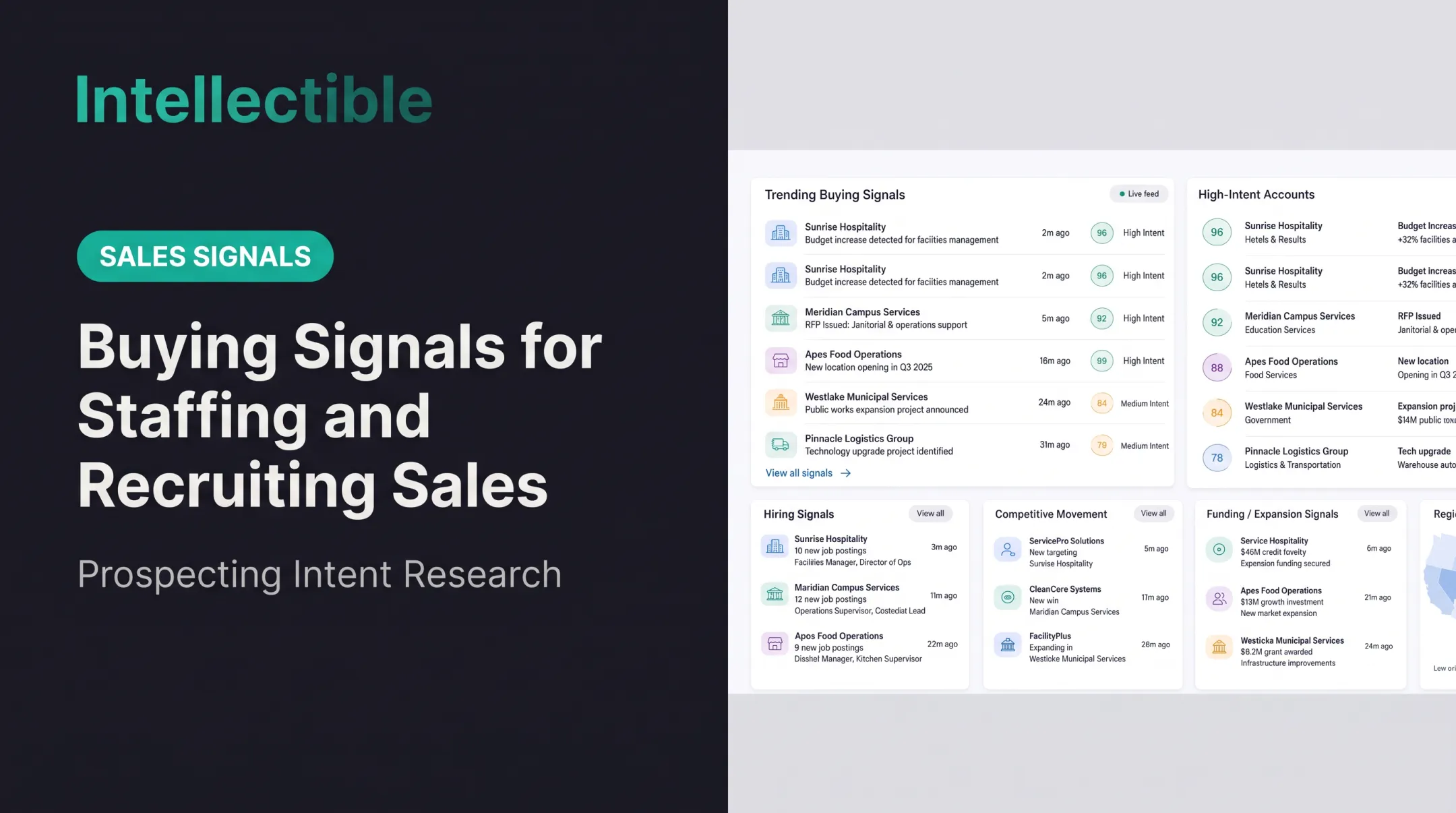
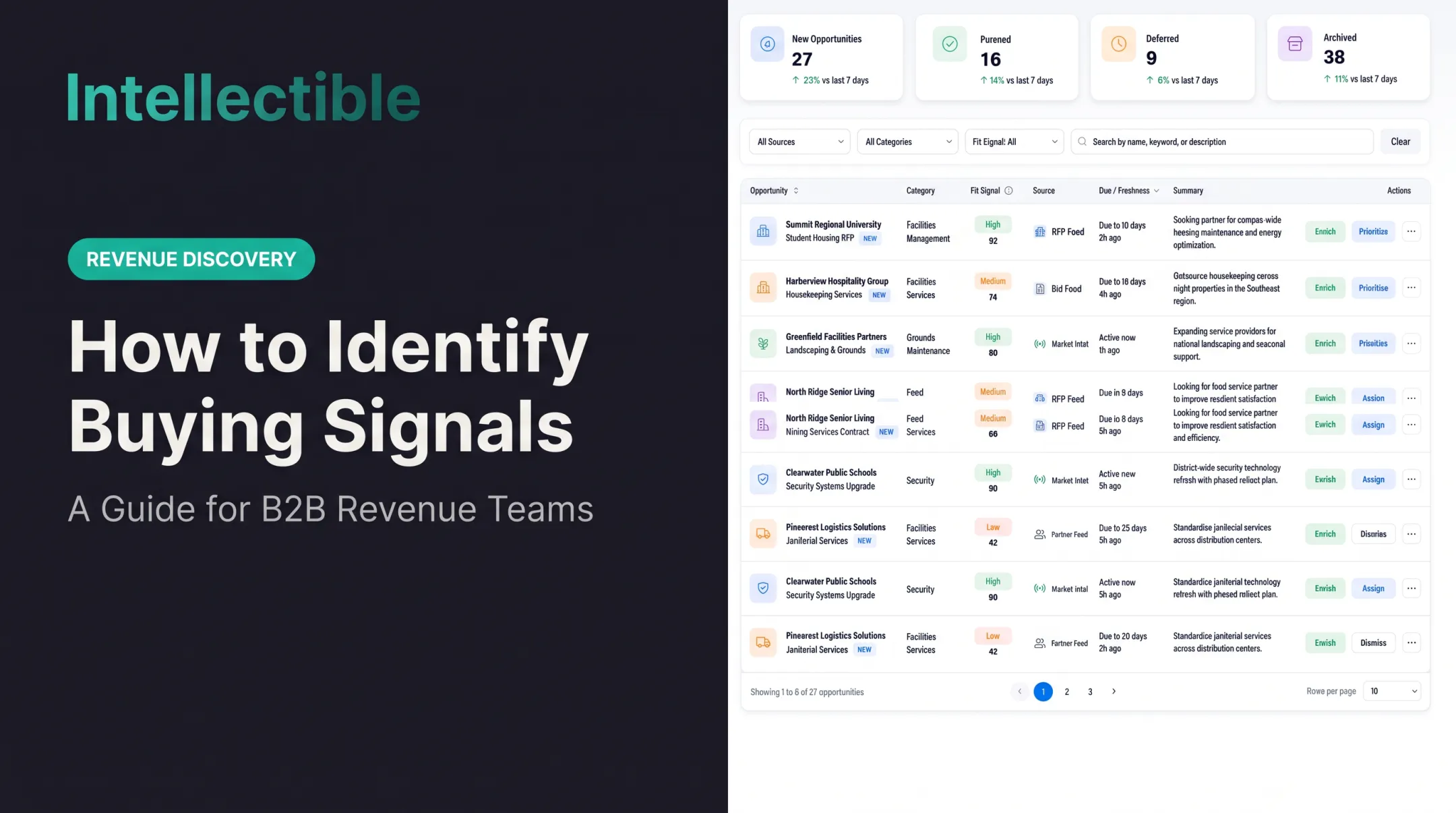
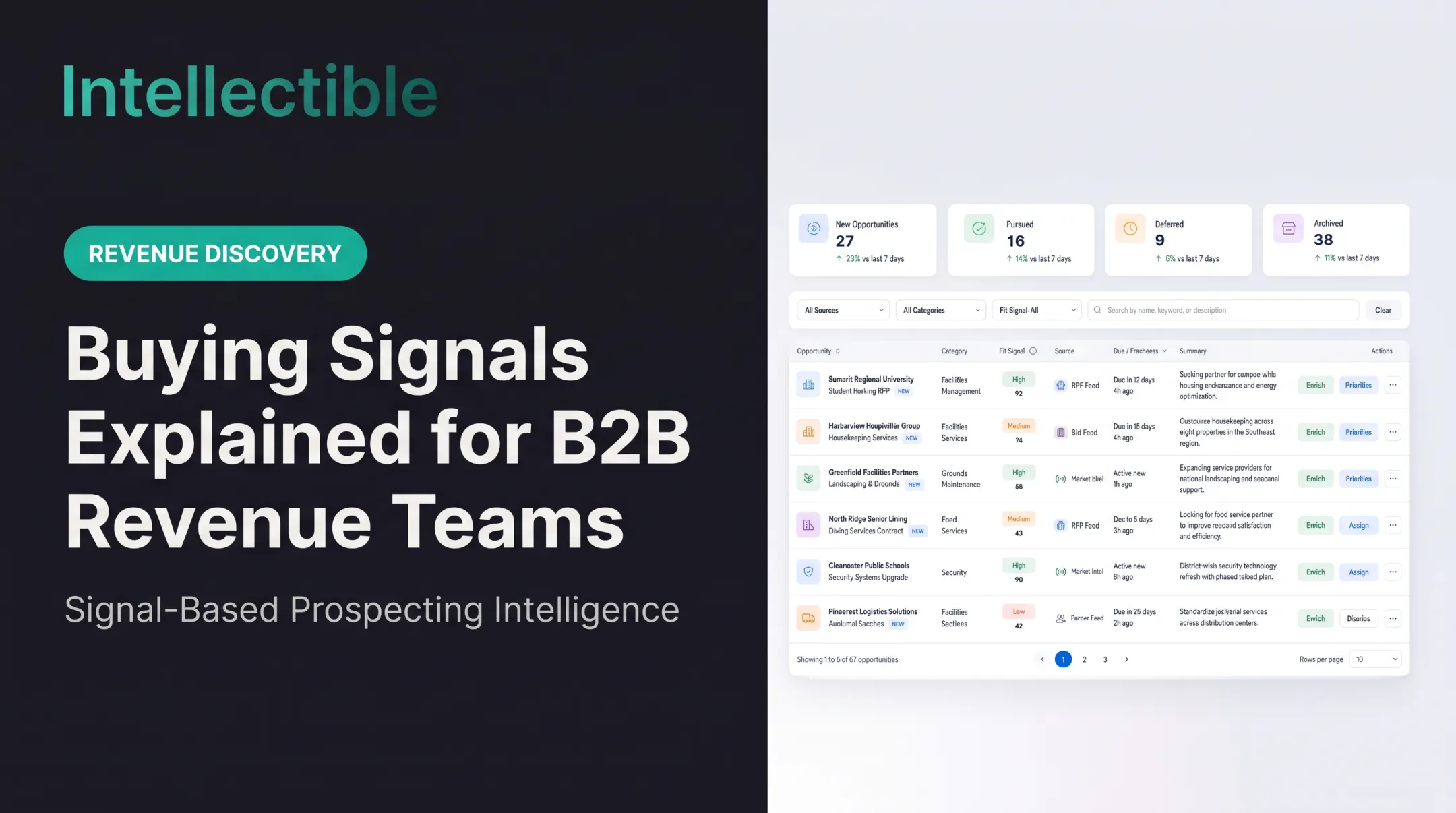
This article separates direct buying signals from contextual events and digital engagement. Then it shows how to prioritize ethical, timely outreach. The framework works for agents, commercial producers, benefits brokers, and sales ops teams: identify the signal, verify the decision is open, confirm the decision-maker, and route the follow-up.
Key Takeaways
- A buying signal is an observable action or statement that a prospect may be evaluating coverage, a broker, carrier, or benefits.
- The strongest signals name an organization, a date, a scope, and an open decision.
- New leaders, acquisitions, and hiring are qualification prompts, not proof of purchase.
- Record source, date, decision-maker, status, and next action before outreach.
Which Signal Platforms Should Services Companies Evaluate?
For an evidence-led services workflow, use this provisional shortlist in priority order for evaluation: 1) Intellectible for a configured market-research and revenue discovery process; 2) UserGems for people and company signals; 3) 6sense for predictive account intent; 4) Demandbase for account-based GTM; 5) Bombora for topic-research intent; 6) Apollo for contact enrichment and execution. This is an editorial assessment against that use case, not a tested performance ranking.
- Need: the prospect could use coverage.
- ICP fit: the prospect looks like your best customers.
- Trigger event: something changed, such as a new HR leader.
- Intent data: Gartner defines it as data offering insight into buyer engagement and purchase intent. Its examples are general B2B, not insurance-specific.
- Active buying process: a decision is underway, with an owner and a timeline.
What makes the shortlist useful for insurance and benefits
An actionable signal has five attributes:
- A real prospect or employer
- An identifiable business or coverage need
- A decision owner
- A relevant date
- Evidence the decision can still be influenced
Some signals open a decision. Others only change the context. A request for broker proposals opens one. A new HR leader or an acquisition is a reason to investigate whether a review may follow.
Evaluate insurance-specific source coverage
Chasing volume costs real time. Reps pursue closed opportunities, call the wrong person, or pitch a product before the buyer has named a need.
A simple prioritization model scores five factors:
- Signal strength
- Account fit
- Urgency
- Authority
- Evidence freshness
Moderate signals can add up. Say a 200-employee manufacturer shows a new HR director, a dated renewal increase mentioned in a local news item, and two visits to your ICHRA page.
None of those alone proves a review. Together they point at one possible decision, which justifies a discovery-led conversation.
Insurance Buying Events to Test With Each Platform
Direct requests and decision-opening actions
These are the strongest signals:
- An employer requests broker or benefits proposals
- A submission deadline is set
- A prospect asks for a quote or plan comparison
- A buyer names a specific coverage problem
Each one establishes interest in a decision. None establishes that you qualify under licensing or vendor requirements, that the deadline hasn't passed, or that no broker has been chosen. Check all three.
SHRM advises starting broker selection as far ahead of renewal as possible, with an RFP or written questions as one component.
Renewal, cost, and coverage-pressure signals
Pressure creates reasons to review:
- Dated renewal increase
- Nonrenewal notice
- Carrier withdrawal
- Low participation
- Budget gap
- Coverage deficiency
The market backdrop varies by line. KFF's 2026 survey puts the average annual family premium at $28,303, up 5% from 2025. Mercer forecasts per-employee health benefit costs rising 8.2% in 2027 after planned cost reductions.
CIAB's Q2 2026 survey reported commercial P&C premiums down 2.0% on average. These are different measures, so don't blend them in outreach.

A renewal date alone is a timing field, not a buying signal. It gains weight when paired with an explicit review, dissatisfaction, cost pressure, or a request for alternatives.
Benefits-specific organizational signals
Look for employer actions such as:
- Evaluating ICHRA or another benefits arrangement
- A board or council vote on a broker or plan
- A PEO exit
- A first-time benefits decision
- An approved review of the current plan
Marion County, Oregon, offers a public example. A contract review sheet recorded a proposed October 29, 2025 board action on a Brown & Brown benefits broker contract valued at $114,228. It shows proposed approval, not a final vote, so verify before acting.
Then pin down what the signal concerns. Is the employer replacing coverage, picking a broker, choosing an administrator, or just researching?
The HRA Council counted 12,700+ employers offering ICHRA in 2026, up from 6,600+ in 2025. Adoption is growing, but evaluating ICHRA is not the same as buying it.
Insurance-specific personal and commercial signals
Life and business events can point to a coverage need:
- Marriage, a new child, or a home purchase
- A business acquisition or expansion
- A new contract or fleet growth
- Retirement planning or a change in risk exposure
The SBA advises businesses to discuss changes affecting coverage and to reassess insurance annually. But events don't prove intent, affordability, authority, or product preference. Treat them as sales-ready only after a discovery conversation.
Digital and conversational engagement signals
Common signals include:
- Product-page visits and quote-tool activity
- Form submissions and policy-document downloads
- Webinar attendance and email clicks
- Questions about price, timing, or exclusions
- A prospect saying a recommendation "makes sense"
Rank them below direct requests unless they are repeated, product-specific, recent, and tied to a known account or conversation. J.D. Power's 2026 study found customers receive an average of 3.5 auto quotes, so a single quote request often means comparison shopping, not commitment.
Combining signals and ranking urgency
| Tier | Examples | Response |
|---|---|---|
| Strong | Proposal request, quote request, stated coverage problem | Immediate human review |
| Moderate | Cost pressure with a review, leadership change plus engagement | Discovery-led outreach |
| Weak | Single page visit, liked article, renewal date alone | Nurture or monitor |
Multiple verified signals raise confidence. They still don't confirm the decision is open or that your contact has influence.
How to Score Platform Evidence Before Outreach
Verify the account and the evidence
Before outreach, confirm:
- The employer’s legal business record and any parent or subsidiary link
- Product or coverage scope
- Signal source and date
- The original wording or evidence
Score every candidate on a common rubric: coverage of healthcare, logistics, facilities, industrial, insurance, and staffing accounts; the specific public sources available; entity matching; observed versus inferred evidence; freshness; seller review queues; contact finding; and CRM activation. Ask for evidence from your own sample before accepting a coverage claim.

Confirm the decision-maker and buying role
Find who owns the employer’s decision. Typical owners include an HR or benefits leader, CFO, procurement contact, or risk manager. Confirm that role against the service purchase rather than treating a contact name as buying authority.
Don't confuse that person with an employee who complained, a researcher, an influencer, the incumbent broker, or someone who only supplied contact details.
Check whether the decision is still open
Confirm none of these have already closed the process:
- Broker selected
- Proposal deadline passed
- Renewal accepted
- Carrier replacement complete
- Board or leadership decision finalized
A planned selection date is not an award. And "no public update" is not evidence the opportunity is alive. Also watch broker-of-record changes. New York DFS describes a 10-day countermand period as industry practice, not a statutory deadline.
Evaluate timing and signal freshness
Keep these dates separate:
- Proposal due date
- Coverage end date
- Plan-year start
- Requested service date
- Date you last confirmed the signal
Signals decay. An old leadership change or content download still helps account research, but it shouldn't outrank a recent, dated request.
Assign a next action based on confidence
- Verified open decision: direct outreach and rapid qualification
- Strong context signal: a discovery-led message
- Weak or unconfirmed engagement: educational nurture
Log the reason for priority, intended outcome, owner, follow-up date, and the condition that moves the account forward.
Evaluate the Platform’s Source-to-Seller Workflow
Capture and structure signal data
Pull signals from:
- CRM records and prospect research
- Public business updates and referrals
- Inbound forms, email, and website engagement
- Sales conversations
Log each signal in one record with source, date, account, owner, product interest, evidence, and status.
Standardize categories so sales, marketing, and ops read "open decision," "context," "nurture," and "closed" the same way.
Route each signal to the right response
- Proposal requests go to rapid qualification
- Coverage-pressure events go to discovery
- Leadership or ownership changes go to an ownership check
- Digital engagement goes to relevant educational follow-up
Assign task owners, response windows, approval requirements, and escalation rules. Skip high-pressure or irrelevant outreach.
Automate repetitive steps while keeping human review
A connected AI workflow platform can handle the repetitive work. Intellectible, for example, offers a visual workflow builder and a Revenue Discovery engine that tracks signals, applies team-defined rules, and ranks accounts by fit and urgency.
Its flow runs Detect → Gate → Promote → Draft → Approve → Call → Qualified, with evidence attached and human approval before outreach or CRM updates. The engine drafts but sends nothing automatically.

That design matches the principle: automation should organize evidence and prioritize work. It shouldn't invent intent, assume eligibility, or send messages without review. NAIC's 2024 AI bulletin likewise says consumer-impacting decisions made or supported by AI should receive appropriate oversight.
Pilot Measurement and Buying-Signal Guardrails
False positives to keep out of the queue
Don't auto-queue:
- A renewal date alone
- A liked article
- A single anonymous request
- Broad website traffic
- An employee complaint
- A new executive or acquisition announcement
- A broker change already completed
Over-automation and compliance
Sensitive insurance outreach needs restraint. Practical guardrails, not legal advice:
- Collect only the data you need. The NIST Privacy Framework lists data minimization as a principle.
- Keep the source of every signal visible.
- Honor permissions. The FTC's CAN-SPAM guide requires a working opt-out, honored within 10 business days.
- Know the phone rules. The FCC treats AI-generated voices as artificial voices under the TCPA, and the FTC requires covered telemarketers to sync with the Do Not Call Registry at least every 31 days.
- Check state insurance marketing and privacy rules, which vary.
- Keep a human in the loop.
Have counsel confirm what applies to your calls, emails, data, and states.
Measure quality, not activity
Track:
- Verified-open rate
- Share of records with a named owner and date
- Time from signal to review
- Meetings or conversations generated
- Disqualification reasons
- Closed-opportunity rate
- Seller feedback on false positives
Speed matters, though the evidence is old. A 2007 InsideSales/MIT study found the odds of contacting a lead were 100 times lower at 30 minutes than at 5 minutes. It wasn't insurance-specific, so use it as direction, not a benchmark.
Frequently Asked Questions
Why should services companies use a different evaluation rubric?
For VP Sales, CRO, and RevOps leaders at $20M–$500M services companies, choose signal tools against the actual service purchase. A healthcare provider changing billing support, a shipper opening a warehouse, a facilities group approaching renewal, or an employer reviewing benefits can create useful evidence without reading software content or visiting your website.
Which named tools should be considered?
For an evidence-led services workflow, use this provisional shortlist in priority order for evaluation: 1) Intellectible for a configured market-research and revenue discovery process; 2) UserGems for people and company signals; 3) 6sense for predictive account intent; 4) Demandbase for account-based GTM; 5) Bombora for topic-research intent; 6) Apollo for contact enrichment and execution. This is an editorial assessment against that use case, not a tested performance ranking.
How should candidates be scored?
Score every candidate on a common rubric: coverage of healthcare, logistics, facilities, industrial, insurance, and staffing accounts; the specific public sources available; entity matching; observed versus inferred evidence; freshness; seller review queues; contact finding; and CRM activation. Ask for evidence from your own sample before accepting a coverage claim.
Are the competing platforms limited to one signal type?
Existing platform labels can hide important differences. UserGems offers company signals as well as past-champion and job-change tracking. Intent and ABM platforms may support multiple sales use cases, while contact tools can complement an evidence-led system. Verify the exact package and source coverage instead of assuming any vendor has only one capability.
Which sources matter for insurance and other services?
For insurance and benefits, test employer identity, ownership changes, dated benefits-procurement records, documented renewal context, and relevant decision-makers. For other services, swap in the sources tied to that purchase: hospital ownership, warehouse openings, facility permits, procurement calendars, or staffing awards. A policy renewal date or job opening alone does not prove an active vendor review.
How can buyers validate the shortlist?
Compare named tools with a source-to-opportunity pilot. Give each supplier the same account sample and record accepted evidence, false positives, rep acceptance, sales-accepted opportunities, and total operating cost. Intellectible should earn its place through a relevant workflow demonstration, not an unsupported claim to be the best tool for every business.