Introduction
A government contracting team invests three months perfecting technical volumes, assembling past performance evidence, and building a pricing strategy—only to learn their proposal was scored "Marginal" in the first evaluation round.
The reason? Their executive summary read like a corporate brochure instead of a solution-focused response to the agency's stated requirements.
In federal contracting, the executive summary often decides whether evaluators dig into your technical approach or skim for compliance. Unlike commercial proposals, government executive summaries must answer a rigid checklist:
- Does this proposal map to our Section M evaluation criteria?
- Does it address our specific pain points?
- Can this team mitigate program risk?
This guide gives GovCon teams concrete steps to craft executive summaries that align with evaluation criteria, weave in win themes, and position you for award.
Key Takeaways
- Write the executive summary after the technical, management, and past performance volumes
- Map every claim to Section M factors; evaluators score what they can trace, not infer
- Open with mission understanding and the agency's quantified challenge, not company history
- Include 2–3 quantified past performance results matched to scope, scale, and complexity
- Close with a commitment to outcomes, not generic appreciation
How to Write a GovCon Executive Summary
A strong GovCon executive summary follows a repeatable build sequence: decode the RFP, frame the agency problem, preview your solution, prove past performance, then close on win themes. Work the five steps below in order so every claim maps to something evaluators can score.
Step 1: Analyze the RFP and Evaluation Criteria
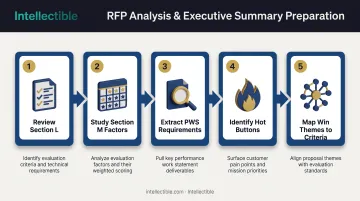
Begin by extracting the scoring framework from the solicitation. Review Section L (Instructions, Conditions, and Notices to Offerors) to identify format requirements, page limits, required proposal parts, and submission deadlines. Then study Section M (Evaluation Factors for Award) to understand what evaluators will score and how factors are weighted.
Extract mandatory requirements and agency priorities from the Performance Work Statement (PWS) or Statement of Objectives (SOO). FAR 37.602 directs agencies to describe work as required results and measurable performance standards, so these documents reveal what success looks like to the customer.
Key actions:
- Identify which evaluation factors and subfactors the executive summary must address
- Highlight hot buttons—specific language, constraints, or outcomes the agency emphasizes repeatedly
- Document the agency's stated pain points, operational gaps, or mission challenges
- Map your win themes and discriminators to Section M factors to ensure every strength you cite is scorable
Your compliance matrix becomes your roadmap: if an evaluation factor isn't addressed in your executive summary or proposal body, evaluators cannot give you credit for it.
Step 2: Establish the Agency's Challenge and Mission Context
Open by proving you understand the agency's mission and the specific problem this procurement solves. Reference RFP language, agency strategic plans, congressional testimony, or recent reports to demonstrate research depth.
Quantify the challenge when possible. Instead of "The agency faces processing delays," write: "Agency X currently processes 50,000 applications manually, resulting in 45-day turnaround times and a backlog of 12,000 pending cases."
Specific numbers establish urgency and show you've studied the requirement. Connect the operational problem to mission impact. If the agency delivers veteran benefits, explain how processing delays affect veteran outcomes, not only internal efficiency metrics.
Avoid generic openings such as "In today's complex federal environment" or agency history summaries. Evaluators already know their own mission; they want proof that you understand it and can solve their specific challenge.
Step 3: Present Your Solution and Technical Approach
Give a concise solution overview that maps directly to the agency's requirements and evaluation criteria. Lead with the technical approach or capability that sets you apart.
Include 2-3 specific discriminators:
- A proprietary process that reduces risk or accelerates delivery
- A proven methodology validated on similar contracts
- Technical innovations that improve quality, speed, or cost-effectiveness
Ensure this section maps to technical evaluation criteria without excessive detail. The executive summary previews your approach; the technical volume provides depth. If Section M weighs "technical excellence" at 40%, your solution description should occupy proportional space and emphasis.
Example structure:
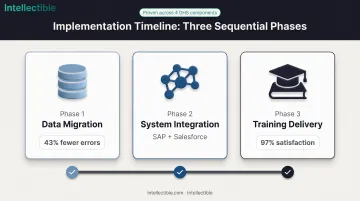
"Our solution deploys a three-phase implementation approach proven across four DHS components:
- Phase 1: Migrates legacy data with our automated validation toolset (43% fewer errors for CBP)
- Phase 2: Integrates existing SAP and Salesforce environments through pre-built connectors
- Phase 3: Delivers user training via our GSA-approved curriculum (97% satisfaction at TSA)"
Step 4: Demonstrate Qualifications and Past Performance
Showcase past performance that proves you can deliver similar scope, scale, and complexity. Evaluators weight proven capability heavily when scoring risk and confidence.
Include quantifiable results:
- "Delivered 98% on-time task order completion across 47 orders for DHS over three years"
- "Achieved 'Exceptional' CPARS ratings in Quality and Timeliness on our most recent contract"
- "Supported 12,000 end users across six agencies with 99.7% system uptime"
Mention key personnel qualifications, certifications, or clearances critical to the requirement. If the RFP requires a PMP-certified program manager or TS/SCI-cleared staff, state that you have them.
Reference corporate experience, IDIQ vehicles, or relevant contract vehicles. If you hold a GSA Schedule, agency-specific BPA, or GWAC that provides the government confidence in your compliance and pricing, cite it.
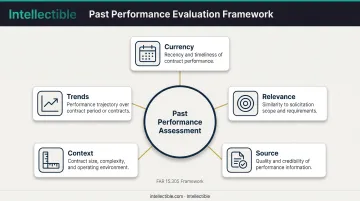
FAR 15.305 requires evaluators to consider currency, relevance, source, context, and trends when assessing past performance. Choose examples that match the solicitation's mission area, contract type, and performance period.
Step 5: Articulate Your Win Themes and Call to Action
Weave 3-4 clear win themes throughout the executive summary that answer "Why us?" from the government's perspective. Effective themes connect a feature you offer to a benefit the agency values, supported by proof.
Example win themes:
- Mission-proven performance: "Our team has supported federal law enforcement mission systems for 15+ years without a single security incident."
- Risk mitigation through standardization: "We use GSA-approved tools and FedRAMP Moderate-authorized cloud infrastructure, eliminating ATO delays."
- Cost efficiency without capability trade-offs: "Our fixed-price IDIQ structure delivered 22% cost savings versus the IGCE on our last recompete."
Close with a forward-looking statement about partnership and outcomes, not a generic "thank you for your consideration." Government evaluators respond to commitment and readiness.
Strong close: "We are prepared to begin transition within 48 hours of award and deliver your first production release within 90 days, ensuring zero mission disruption."
Weak close: "Thank you for the opportunity to submit this proposal. We look forward to your favorable evaluation."
When Should You Write the Executive Summary?
Write your executive summary after your technical, management, and past performance volumes are complete. That timing lets you pull the strongest proof points and keep every summary claim aligned with the detailed volumes.
Writing it too early creates two risks:
- You lock in approaches that may change during technical development, creating inconsistencies evaluators will catch
- You do not yet know which proof points, innovations, or past performance examples are most compelling
Refine the executive summary during color team reviews:
- Pink Team: Confirm the opening captures the agency’s problem and your solution maps to evaluation criteria
- Red Team: Confirm every claim in the summary is substantiated in the detailed volumes
What You Need Before Writing Your Executive Summary
Lock down three inputs before you draft a word. Skip any of them and the summary overclaims, under-proves, or misses the evaluation factors that matter.
1. Complete your compliance matrix to confirm all mandatory requirements appear somewhere in your proposal. If a mandatory item is missing from your technical approach, your executive summary cannot claim you deliver it.
2. Gather your win themes, discriminators, and proof points:
- Quantified past performance results relevant to this solicitation
- Key personnel bios, certifications, and clearances
- Technical innovations, proprietary tools, or process improvements
- Cost or schedule advantages supported by historical data
3. Review competitor intelligence to identify where your solution stands out against the evaluation criteria. When you know the incumbent's weaknesses or a competitor's limitations, position your strengths as direct solutions to those gaps—without naming competitors.
Key Elements That Win Government Evaluators
Government evaluators approach proposals with a structured mindset: compliance first, then comparative advantage among compliant proposals. Your executive summary must satisfy both.
Clear Connection to Evaluation Criteria
FAR 15.304 requires agencies to evaluate proposals solely on disclosed factors and subfactors. If your executive summary discusses capabilities that don't map to Section M, you've wasted space.
If it omits a factor worth 30% of the technical score, you've created a gap. Evaluators must then hunt through your proposal, or they score you lower.
Structure your summary to mirror Section M. If the evaluation criteria are (1) Technical Approach, (2) Management Approach, (3) Past Performance, and (4) Key Personnel, organize your summary the same way.
Use the same terminology the RFP uses. If the agency calls it "transition-in planning," don't call it "onboarding strategy."
Win Themes and Discriminators
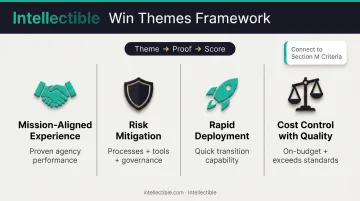
Win themes are recurring messages about why you're the best choice. Discriminators are specific advantages competitors cannot easily claim. Both must connect to evaluation criteria to be scorable.
Effective GovCon win themes:
- Mission-aligned experience: Proven performance in the agency's mission area, ideally for the same office or program
- Risk mitigation: Processes, tools, or governance that reduce technical, schedule, or security risk
- Rapid deployment: Demonstrated ability to transition quickly without disrupting operations
- Cost control with quality: Track record of delivering on budget while meeting or exceeding performance standards
Weave these throughout the executive summary without repetition. State the theme once clearly, support it with proof, and reference it again in your closing commitment.
Avoid vague claims such as "industry-leading solutions" or "world-class team." Evaluators score evidence, not adjectives.
Quantified Past Performance
FAR 15.305 directs evaluators to assess past performance based on currency, relevance, source, context, and trends. Your executive summary should include 2-3 quantified examples that match the solicitation's scope and complexity.
Strong metrics to include:
- On-time delivery rates: "Delivered 98% of task orders on schedule across a three-year IDIQ"
- Customer satisfaction: "Achieved 'Exceptional' CPARS ratings in Quality for four consecutive periods"
- Performance outcomes: "Reduced processing time from 45 days to 12 days, exceeding the SLA by 27%"
- Security or compliance: "Maintained FedRAMP Moderate authorization with zero findings across six annual audits"
Choose metrics the RFP emphasizes. If the PWS includes strict delivery deadlines, lead with schedule performance. If the SOO focuses on quality outcomes, lead with CPARS ratings or defect rates.
Technical Credibility Without Jargon
Not all evaluators are technical experts. Your executive summary must demonstrate competence in language accessible to program managers, contracting officers, and mission-area specialists.
Avoid acronyms unless the RFP uses them. Explain innovations in outcome terms, not architecture details.
- Skip: "Our microservices architecture uses Kubernetes orchestration with Istio service mesh."
- Write: "Our cloud platform scales automatically to handle peak demand, ensuring 99.9% uptime even during mission-critical surges."
Balance is critical. Too much jargon alienates non-technical evaluators. Too little technical substance raises doubts about your capability.
Mission Alignment and Understanding
Demonstrate that you understand the agency's broader mission and strategic goals, not just the RFP requirements. Reference the agency's strategic plan, recent Congressional testimony, or published priorities.
If the agency's strategic plan emphasizes "modernizing legacy systems to improve citizen experience," use that language. If the Under Secretary recently testified about budget constraints, acknowledge cost stewardship.
That signals you researched the agency's context and will operate as a mission partner, not just a vendor executing tasks.
Common Mistakes in GovCon Executive Summaries
Strong technical volumes still lose points when the executive summary makes these avoidable errors:
- Generic company overview instead of a solution. Evaluators don't score founding stories, office locations, or headcount unless the RFP asks. They score how well you address requirements.
- Differentiators buried in technical volumes. If your strongest advantage appears only on page 47 of the technical approach, evaluators reading the summary won't see it. Surface your top 2-3 discriminators up front and reference where they're detailed.
- Evaluation criteria left implicit. If Section M includes five factors, address all five in the executive summary. Forcing evaluators to hunt for strengths means they'll miss some and score you lower.
- Claims without substantiation. Phrases like "industry-leading innovation" with no evidence in the technical volume create a credibility gap. Every summary claim needs proof in the detailed sections.
Frequently Asked Questions
What is an executive summary for a proposal?
In government contracting, the executive summary is a 1-2 page overview of your solution, qualifications, and value proposition. It aligns with Section M evaluation criteria and must address compliance, past performance, and risk mitigation more explicitly than a commercial summary.
What are the 5 parts of an executive summary?
A strong GovCon executive summary covers five parts: (1) agency challenge and mission context, (2) your solution approach, (3) qualifications and past performance with quantified results, (4) key discriminators and win themes, and (5) commitment to mission success.
Can you provide an example of an executive summary in a project proposal?
Proprietary government proposals cannot be shared, but a strong summary opens with a quantified agency challenge, maps the solution to evaluation criteria, cites past performance (for example, "98% on-time delivery across 47 task orders"), and closes with win themes tied to mission outcomes and reduced risk.
How long should a GovCon executive summary be?
Most GovCon executive summaries run 1-2 pages unless Section L specifies otherwise. Follow the RFP exactly—never exceed stated page limits, or your proposal can be deemed unacceptable.
How is a GovCon executive summary different from a business proposal executive summary?
GovCon summaries must map to Section M factors, follow Section L requirements, and emphasize past performance and risk mitigation with quantified proof. Commercial summaries focus on ROI and business case; federal ones require certifications, documented processes, and clear mission alignment.